INDIA BEYOND GLOBAL POLITICS
In 21st century India’s evolving approach represents not disengagement from world affairs but a redefinition of how global power operates.
MEET PARMAR
3/3/20264 min read
Abstract
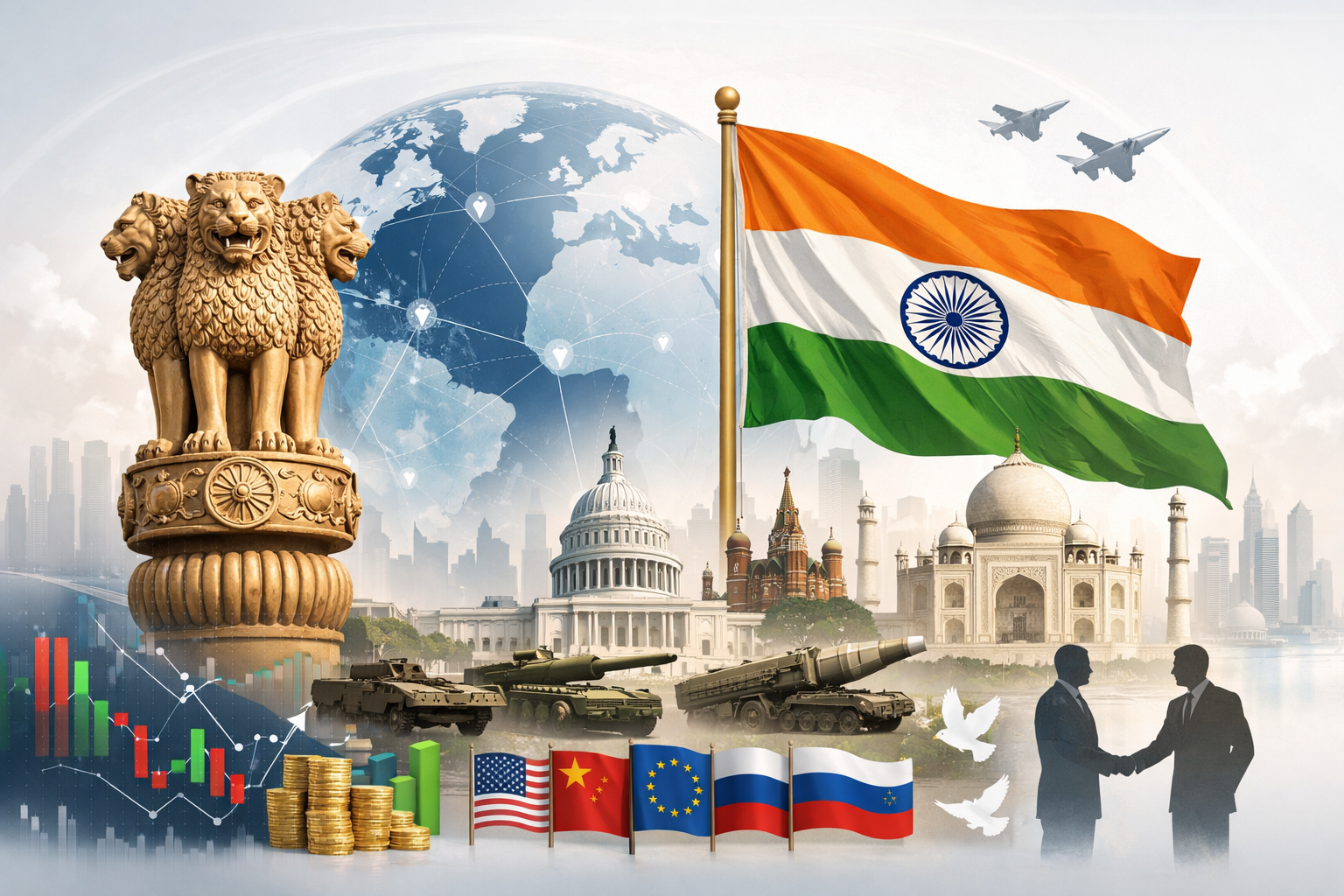
The contemporary global order is undergoing a profound transformation marked by geopolitical rivalry, economic fragmentation, intelligence competition, and shifting alliances. Amid these changes, India has emerged as a unique actor that neither conforms to traditional power blocs nor withdraws into isolationism. Instead, India is developing a model of strategic autonomy rooted in economic diplomacy, national resilience, and multi-alignment. This article argues that India is moving beyond conventional global politics by balancing competing powers, countering external destabilization efforts, managing regional security challenges such as tensions with Pakistan, and expanding global influence through trade partnerships and technological leadership. India’s evolving approach represents not disengagement from world affairs but a redefinition of how global power operates in the 21st century.
Introduction: A World in Transition
The international system today is no longer governed by predictable alliances or ideological camps. The post-Cold War optimism of globalization has given way to strategic competition, economic nationalism, and hybrid conflicts combining military pressure with cyber and intelligence operations. In this uncertain environment, many nations find themselves compelled to align with dominant powers.
India, however, has charted a different course. Rather than choosing sides, it has chosen strategic flexibility. India’s foreign policy increasingly reflects an ability to cooperate with competing global actors while safeguarding sovereign decision-making. This evolving posture suggests that India is not merely participating in global politics — it is operating beyond its traditional boundaries.
From Non-Alignment to Strategic Autonomy
India’s diplomatic philosophy has deep historical roots. Under Jawaharlal Nehru, India championed the Non-Aligned Movement, refusing to join either the American or Soviet blocs during the Cold War. While non-alignment initially reflected geopolitical caution, today it has evolved into strategic autonomy.
Modern India practices multi-alignment — engaging simultaneously with diverse and often rival powers. Cooperation with the United States in defense technology and innovation exists alongside continued defense and energy engagement with Russia, while maintaining diplomatic outreach across Asia, Africa, and the Middle East.
This approach allows India to maximize opportunity without sacrificing independence, making foreign policy an instrument of national interest rather than ideological loyalty.
Economic Diplomacy: Trade as a Strategic Weapon
Economic strength has become the foundation of India’s geopolitical independence. Trade agreements are no longer merely commercial arrangements; they are instruments of strategic positioning.
India’s expanding trade negotiations with the European Union, the United Kingdom, Gulf economies, and Indo-Pacific partners reflect a deliberate effort to diversify markets and reduce dependency on any single economic sphere. These agreements aim to strengthen manufacturing, pharmaceuticals, digital services, and supply-chain resilience.
By leveraging its large domestic market and growing industrial base, India negotiates from a position of increasing confidence. Economic diplomacy enables India to maintain autonomy in political decisions because economic security reduces vulnerability to external pressure.
India–Pakistan Conflict and Regional Security Realities
India’s rise occurs within a challenging regional security environment. Relations with Pakistan remain shaped by historical disputes and recurring concerns over cross-border terrorism.
Recent tensions following terrorist incidents and subsequent military responses demonstrated India’s evolving doctrine: calibrated retaliation combined with diplomatic restraint. Rather than escalating into prolonged warfare, India has increasingly relied on targeted operations, international engagement, and strategic signalling to protect national security while preventing uncontrolled escalation.
This balanced response reflects India’s broader global posture — assertive yet measured, defensive yet strategically calculated.
Intelligence Warfare and Attempts at Destabilization
Modern geopolitics increasingly operates in the shadows through intelligence operations, cyber warfare, and information manipulation. Across the world, intelligence agencies attempt to influence domestic politics, amplify social divisions, or destabilize emerging powers.
India has not been immune to such pressures. External actors have historically attempted to exploit regional, religious, and political fault lines to create internal instability. Disinformation campaigns, cyber threats, and covert support to extremist networks represent components of this hybrid warfare environment.
However, India’s response has combined strengthened intelligence coordination, counter-terrorism measures, cybersecurity expansion, and legal frameworks designed to protect democratic institutions. Equally important has been the role of public awareness and democratic participation, which reduce the effectiveness of external interference. The resilience of Indian society — expressed through electoral legitimacy and institutional continuity — acts as a critical defense mechanism against destabilization efforts.
India as the Voice of the Global South
India’s influence increasingly extends beyond regional politics into global governance. By advocating equitable development, climate justice, and reform of international institutions, India positions itself as a representative of developing nations.
Its leadership role within the G20 demonstrated an effort to bridge divides between advanced economies and emerging markets. Rather than promoting dominance, India emphasizes inclusivity — giving voice to countries often marginalized in global decision-making.
This positioning enhances India’s moral and diplomatic capital, allowing it to function as a mediator and consensus builder in a polarized world.
Technology, Innovation, and Soft Power Influence
India’s growing technological ecosystem has become another pillar of international influence. Digital public infrastructure, space exploration achievements, and affordable technological solutions have enhanced India’s reputation as a provider of scalable governance models for developing nations.
Unlike traditional powers that export ideology or military presence, India increasingly exports solutions — digital systems, healthcare cooperation, and innovation partnerships. This form of influence strengthens diplomatic relationships without coercion.
Challenges and Contradictions
Despite its growing stature, India faces significant challenges:
Persistent border tensions and regional instability.
Energy dependence amid global market volatility.
Socioeconomic disparities requiring sustained domestic reform.
The need for rapid defense modernization in an increasingly uncertain security environment.
Acknowledging these challenges is essential, as India’s success in transcending traditional geopolitics depends on balancing domestic stability with global ambition.
Conclusion: Redefining Global Politics
India’s trajectory suggests the emergence of a new diplomatic paradigm. Rather than aligning permanently with any geopolitical bloc, India practices flexible engagement guided by sovereignty, economic pragmatism, and strategic calculation. Its responses to regional conflicts, external intelligence pressures, and global economic negotiations demonstrate a nation confident in its independent path.
India is not stepping away from global politics; it is transforming how global politics functions. In a world increasingly divided by rivalry and distrust, India offers a model built on autonomy without isolation, engagement without dependence, and power exercised through balance rather than domination.
As the international order continues to evolve, India’s rise signals a broader shift — from a world defined by competing camps to one shaped by sovereign partnerships. In that transition, India stands not merely as a participant, but as an architect of the emerging global equilibrium.