Indian Education System - Part 1
This article explores the complete evolution of the Indian education system—from the Gurukul tradition and ancient universities like Nalanda and Takshashila to the medieval period, British colonial education, post-independence reforms, reservation policies, examination scandals, student movements, and the National Education Policy 2020. It presents a balanced historical perspective on India's educational achievements, social inequalities, policy changes, and contemporary challenges, offering readers a comprehensive understanding of how the nation's education system has evolved over thousands of years and the reforms needed to shape its future.
Meet Parmar
7/22/20265 min read
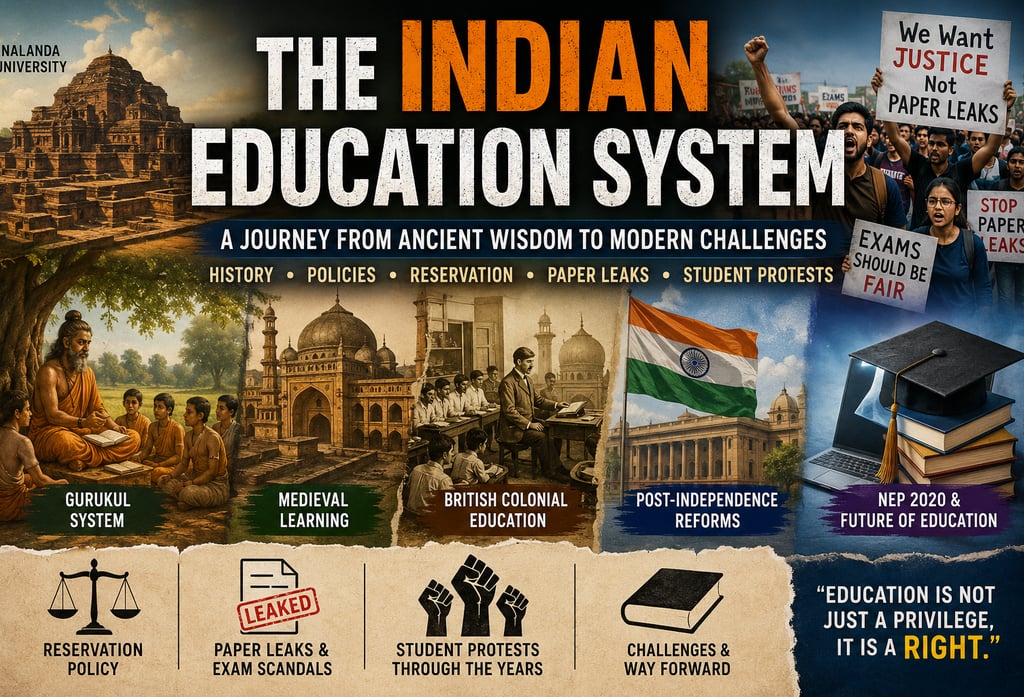
The Indian Education System: From Ancient Wisdom to Modern Challenges
Part 1 – Origins of Indian Education: The Birth of Knowledge, Social Hierarchy, and the Evolution Before Colonial Rule
Introduction
Education is often described as the backbone of a nation. It shapes societies, determines economic growth, nurtures scientific innovation, and preserves cultural heritage. India, one of the world's oldest civilizations, possesses an educational history stretching back thousands of years. Long before many modern universities existed, India had established renowned centres of learning that attracted scholars from across Asia and beyond. Ancient universities such as Takshashila, Nalanda, and Vikramashila became symbols of intellectual excellence, while the Gurukul system emphasized holistic education, discipline, and moral values.
However, the story of Indian education is not merely one of intellectual brilliance. Alongside remarkable achievements existed significant social inequalities. Access to education often depended on caste, gender, wealth, occupation, and geography. Over centuries, education evolved through the influence of Hindu, Buddhist, Jain, Islamic, and later British traditions, each leaving a lasting impact on the system that exists today.
Modern India inherited not only one of the richest educational traditions in human history but also many unresolved challenges—including social inequality, unequal access, commercialization, examination pressure, policy debates, and institutional weaknesses. Understanding these contemporary issues requires examining the complete historical journey of Indian education.
This article traces that journey from ancient civilization to the present day, exploring both the achievements and shortcomings of India's educational evolution.
The Beginning of Education in Ancient India
Education in India predates recorded history. Archaeological discoveries from the Indus Valley Civilization (approximately 2600–1900 BCE) reveal a highly organized urban society with advanced knowledge of engineering, sanitation, architecture, standardized measurements, and trade. Although no direct evidence of formal schools has been found, the sophistication of the civilization indicates that knowledge was systematically transmitted across generations.
The formal educational traditions of India became more visible during the Vedic period (approximately 1500–500 BCE).
The word "Vidya", meaning knowledge, occupied a sacred position within Indian philosophy. Learning was considered a path toward self-realization rather than merely a means of earning a livelihood. Education aimed to develop intellectual ability, ethical values, discipline, spiritual understanding, and practical skills simultaneously.
Unlike many modern education systems that emphasize examinations and employment, ancient Indian education focused on the complete development of the individual.
The Gurukul System
The Gurukul system became the foundation of education during the Vedic period.
Students, known as Shishyas, lived with their teacher or Guru in residential institutions called Gurukuls. Education was not limited to classroom instruction. Students participated in daily life alongside their teachers, learning discipline, responsibility, agriculture, physical fitness, debate, meditation, and community service.
The relationship between guru and disciple was considered sacred. Knowledge was regarded as something to be earned through dedication rather than purchased through fees.
Teaching methods relied heavily on:
Oral traditions
Memorization
Question-and-answer discussions
Logical debate
Practical demonstrations
Observation of nature
Meditation
Ethical instruction
Students often spent many years under the guidance of a single teacher before returning to society.
Subjects Taught
Contrary to the common misconception that ancient education consisted only of religious instruction, the curriculum was remarkably diverse.
Students studied:
Sanskrit grammar
Literature
Philosophy
Logic (Nyaya)
Mathematics
Geometry
Astronomy
Astrology
Ayurveda (medicine)
Surgery
Agriculture
Economics
Political science
State administration
Diplomacy
Warfare
Music
Dance
Sculpture
Architecture
Ethics
Environmental knowledge
Indian mathematicians later introduced concepts such as zero, the decimal system, algebraic developments, and important advances in trigonometry that profoundly influenced global mathematics.
Similarly, Ayurvedic scholars developed sophisticated medical knowledge, while astronomers accurately estimated planetary movements centuries before similar advances in Europe.
Ancient Universities: India's Global Educational Legacy
Long before Oxford, Cambridge, Harvard, or Bologna were founded, India had already established internationally respected centres of higher learning.
Takshashila
Founded around the 6th century BCE in present-day Pakistan, Takshashila became one of the world's earliest known universities.
Students traveled from regions corresponding to modern India, Nepal, Tibet, Sri Lanka, Central Asia, Persia, and China.
Subjects included:
Medicine
Military science
Political administration
Philosophy
Economics
Mathematics
Commerce
Fine arts
One of its most famous scholars was Chanakya (Kautilya), author of the Arthashastra, whose work on economics, diplomacy, governance, and strategy remains influential today.
Nalanda University
Established during the Gupta period in the 5th century CE, Nalanda became one of history's greatest universities.
Historical accounts suggest:
Thousands of resident students.
Hundreds to thousands of teachers.
A vast library with millions of manuscripts according to later traditional accounts (the exact number remains debated by historians).
Students arriving from China, Korea, Japan, Tibet, Southeast Asia, and other regions.
Nalanda offered advanced education in:
Buddhist philosophy
Logic
Medicine
Astronomy
Mathematics
Literature
Linguistics
Fine arts
Admission standards were reportedly rigorous, with applicants undergoing challenging oral examinations.
The destruction of Nalanda in the late twelfth century during invasions in northern India marked a major loss to the intellectual heritage of the region, although historians continue to debate the full circumstances and extent of its decline.
Vikramashila University
Founded during the Pala dynasty, Vikramashila became another internationally respected institution known especially for Buddhist philosophy and advanced scholarship.
Its graduates played a significant role in spreading knowledge across Tibet and East Asia.
Knowledge Beyond Religion
Ancient Indian education is sometimes portrayed exclusively as religious learning, but historical evidence shows a broader intellectual tradition.
Indian scholars contributed to:
Mathematics
Aryabhata developed important work on algebra, trigonometry, and astronomy.
Brahmagupta formalized mathematical operations involving zero and negative numbers.
Bhaskaracharya advanced calculus-like concepts centuries before Newton and Leibniz.
Medicine
Sushruta is often referred to as one of the pioneers of surgery.
Charaka systematized Ayurvedic medicine through extensive medical texts.
Astronomy
Ancient astronomers calculated eclipses, planetary movements, Earth's circumference, and the length of the solar year with remarkable accuracy for their time.
Education and Social Hierarchy
While ancient India achieved extraordinary intellectual accomplishments, access to education was not equally distributed.
Society gradually became organized around the varna framework, which later evolved into a more complex and localized caste system (jati). Over time, access to certain forms of learning, especially Vedic education, became increasingly associated with social status.
In many regions and periods:
Brahmins generally had the greatest access to Vedic education and priestly learning.
Kshatriyas were educated in governance, military science, administration, and statecraft.
Vaishyas often received education related to trade, agriculture, finance, and commerce.
Many Shudra communities had more limited access to formal Vedic instruction, though they often acquired practical and occupational knowledge through family and community traditions.
Communities now recognized as Scheduled Castes (historically treated as "untouchable" in many areas) faced severe exclusion from mainstream educational institutions in numerous regions.
It is important, however, to avoid oversimplification. Ancient India extended over many centuries and diverse kingdoms, so educational practices varied considerably across regions and periods. There was no single uniform system applied everywhere.
Nevertheless, historical evidence indicates that caste-based restrictions on access to formal education became deeply entrenched in many parts of the subcontinent, leaving long-lasting social consequences.
The Story of Ekalavya: Merit and Exclusion
One of the most frequently discussed narratives concerning access to education appears in the Mahabharata.
According to the epic, Ekalavya, a talented young archer from a forest-dwelling community, wished to study under Guru Dronacharya. Dronacharya refused to teach him. Ekalavya nevertheless trained himself by practicing before a clay image of the guru and became an exceptional archer. Later, Dronacharya demanded Ekalavya's right thumb as guru dakshina, limiting his ability to compete with Arjuna.
Historians regard this episode as a literary and cultural narrative rather than direct historical evidence, but it has long been interpreted in discussions about merit, exclusion, and unequal access to education.
Women and Education in Ancient India
The history of women's education in ancient India is equally complex.
Early Vedic literature mentions learned women such as Gargi Vachaknavi, Maitreyi, and Lopamudra, who participated in philosophical debates and composed Vedic hymns. Their presence demonstrates that women could attain high levels of scholarship in some contexts.
Over time, however, opportunities for women narrowed in many regions. Social practices such as child marriage, patriarchal norms, restrictions on mobility, and changing religious and political conditions reduced access to formal education for many girls.
By the medieval period, female literacy had declined significantly in several parts of India, although the extent of this decline varied across communities and regions.
The Transition Toward the Medieval Era
As India entered the medieval period, its educational landscape changed substantially. Buddhist monasteries declined in many regions, new Islamic centres of learning emerged, Persian became an important language of administration under several dynasties, and the structure of patronage shifted. The interaction of these developments reshaped educational institutions long before the arrival of British colonial rule.
In Part 2, we will examine the medieval period and then explore in depth how British colonial policies transformed Indian education, including indigenous schools, Macaulay's Minute, missionary education, the Orientalist–Anglicist debate, Wood's Despatch, the rise of English education, and the long-term consequences that continue to influence India today.