Indian Education System - Part 2
This part explores the transformation of India's education system during British colonial rule and its evolution after Independence. It examines indigenous education, the Orientalist–Anglicist debate, Macaulay's Minute, Wood's Despatch, the rise of English education, the establishment of modern universities, and the impact of colonial policies on traditional learning. The article also discusses post-independence educational reforms, the constitutional vision for education, the origins and evolution of reservation policies, and major education initiatives, including the National Education Policies of 1968, 1986, and NEP 2020, providing a balanced perspective on how historical decisions continue to shape India's education system today.
Meet Parmar
7/22/20267 min read
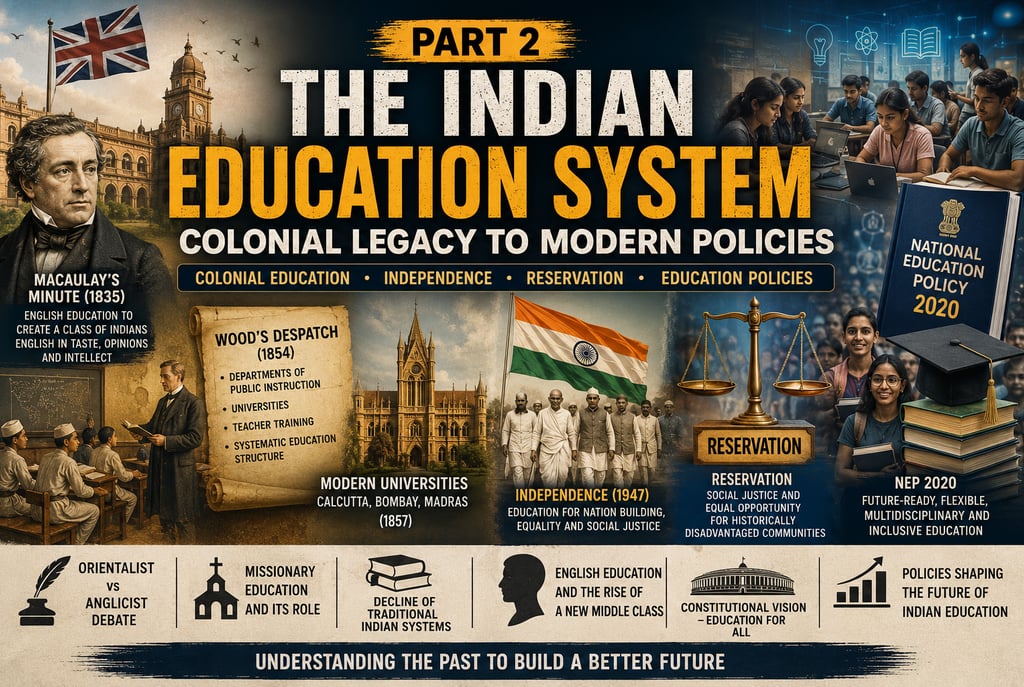
The Indian Education System: From Ancient Wisdom to Modern Challenges
Part 2 – Colonial Education, Independence, Reservation, and the Evolution of Modern Educational Policies
In the previous part, we explored the origins of education in ancient India, the Gurukul system, world-renowned universities such as Takshashila and Nalanda, the development of scientific knowledge, and the social inequalities that influenced access to education. As India entered the medieval period, its educational landscape evolved through the emergence of new institutions, languages, and systems of patronage. However, the most profound transformation came with the expansion of British colonial rule. The colonial administration did not merely introduce new schools; it fundamentally reshaped the purpose, language, structure, and governance of education in India. Many features of today's education system—including English-medium instruction, centralized examinations, universities, and administrative schooling—have their roots in this period.
Education During the Medieval Period (1200–1757)
Before British rule, education in India continued under a variety of institutions that reflected the country's religious and cultural diversity.
Hindu communities maintained Gurukuls, Pathshalas, Agraharams, and Tols, where Sanskrit, grammar, philosophy, mathematics, astronomy, literature, and law were taught.
Islamic rulers established Madrasas and Maktabs, which focused on:
Arabic
Persian
Islamic jurisprudence
Theology
Mathematics
Medicine
Astronomy
Literature
Persian gradually became the language of administration under several Muslim dynasties, making Persian education valuable for government employment.
Although educational traditions differed, India continued to possess a vibrant network of locally supported schools funded by temples, mosques, charitable endowments, village communities, merchants, and regional kingdoms.
However, education remained unequal. Access often depended on caste, class, religion, gender, occupation, and regional customs. Large sections of the rural population still had little or no formal education.
The Arrival of the British East India Company
When the British East India Company established political control after the Battle of Plassey (1757), its primary objective was commerce and governance—not education.
For several decades, the Company invested little in public education. Traditional institutions continued to function largely as before, supported by local communities and religious endowments.
As British rule expanded, however, colonial administrators increasingly viewed education as an instrument of governance.
Their objectives included:
Training clerks and civil servants for the colonial administration.
Creating a class of English-educated intermediaries between British rulers and Indian society.
Standardizing administrative knowledge.
Expanding the use of English in government.
Supporting the dissemination of Western scientific and legal knowledge.
In some contexts, facilitating the work of Christian missionary organizations.
Education thus became closely linked to colonial administration.
Indigenous Education Before Colonial Reforms
Before large-scale British educational reforms, India possessed thousands of indigenous schools.
Historical surveys conducted by British officials such as William Adam (Bengal) and Thomas Munro (Madras Presidency) documented numerous village schools, although the quality, curriculum, and accessibility varied across regions.
These institutions commonly taught:
Reading and writing in local languages.
Arithmetic.
Business accounting.
Agriculture.
Sanskrit literature.
Philosophy.
Logic.
Persian and Arabic in relevant regions.
Religious texts.
Traditional medicine.
Astronomy.
Many schools operated with financial support from village communities, temples, local rulers, merchant guilds, and charitable donations.
The system was decentralized rather than controlled by a single authority.
The Charter Act of 1813
The Charter Act of 1813 marked the first major intervention by the British government in Indian education.
It allocated funds for educational development and allowed Christian missionaries greater freedom to establish schools throughout British India.
Missionary institutions introduced:
English education.
Western sciences.
Modern mathematics.
Printing technology.
Teacher training.
Many missionary schools also included Bible instruction and Christian religious education, particularly in privately managed institutions.
However, it is historically inaccurate to claim that only Christian books were taught during British rule. Government schools and universities also taught literature, mathematics, science, law, geography, philosophy, and administrative subjects. The influence of missionary education was substantial but formed only one part of the broader colonial educational landscape.
The Orientalist–Anglicist Debate
During the early nineteenth century, British policymakers disagreed over the direction of Indian education.
The Orientalists believed education should continue in Sanskrit, Persian, and Arabic while preserving India's traditional systems of learning.
The Anglicists argued that English should become the principal language of higher education and that Western knowledge should receive greater official support.
This debate ultimately shaped the future of Indian education.
Thomas Babington Macaulay and the Minute on Education (1835)
One of the most influential figures in the history of Indian education was Thomas Babington Macaulay.
In his famous Minute on Indian Education (1835), Macaulay argued that government resources should prioritize English-language education and European knowledge rather than traditional Sanskrit and Arabic institutions.
His often-quoted objective was to create:
"...a class of persons, Indian in blood and colour, but English in tastes, in opinions, in morals, and in intellect."
This statement has become one of the most debated passages in colonial history.
Governor-General Lord William Bentinck largely accepted Macaulay's recommendations.
Consequences of Macaulay's Policy
Macaulay's reforms had far-reaching consequences.
Positive Outcomes
Expansion of English education.
Access to modern science and technology.
Introduction of Western medicine.
Development of professional education.
Growth of journalism.
Emergence of lawyers, engineers, doctors, and administrators.
Creation of an educated middle class.
Improved communication across different linguistic regions.
Many leaders of India's freedom movement—including lawyers, journalists, economists, and political thinkers—received education through institutions influenced by this system.
Negative Consequences
At the same time, critics argue that colonial policies:
Reduced official patronage for many traditional institutions.
Elevated English above many Indian languages in higher education.
Encouraged examination-oriented learning.
Created a social divide between English-educated elites and the wider population.
Weakened numerous Gurukuls, Pathshalas, and Sanskrit institutions by redirecting state resources and employment incentives.
It is important to recognize that historians generally attribute the decline of traditional education to multiple factors, including colonial policy, economic change, the loss of royal patronage, and broader social transformations—not solely to Macaulay's Minute.
Wood's Despatch (1854)
Often called the "Magna Carta of English Education in India," Wood's Despatch established the administrative foundation of modern education.
Its recommendations included:
Departments of Public Instruction.
Teacher training colleges.
Government inspection of schools.
Expansion of primary education.
Universities in major cities.
Standardized examinations.
A structured education system from primary school to university.
Much of India's present educational administration can trace its origins to these reforms.
The Rise of Modern Universities
The British established universities in:
Calcutta (1857)
Bombay (1857)
Madras (1857)
These institutions introduced:
Degree programmes.
Modern examinations.
Scientific laboratories.
Medical education.
Legal education.
Engineering education.
Although access remained limited, these universities became centres of intellectual and political debate.
Education and the Indian Freedom Movement
Ironically, the education system introduced to strengthen colonial administration also produced many of the leaders who challenged British rule.
English education enabled Indian intellectuals to study:
Liberal political philosophy.
Constitutional law.
Economics.
Human rights.
Democracy.
Leaders such as Dadabhai Naoroji, Gopal Krishna Gokhale, Bal Gangadhar Tilak, Mahatma Gandhi, Jawaharlal Nehru, Dr. B. R. Ambedkar, Sarojini Naidu, Subhas Chandra Bose, and many others used modern education to critique colonial policies and mobilize the independence movement.
Education thus became a powerful instrument of political awakening.
Education After Independence (1947 Onwards)
India achieved independence on 15 August 1947.
The new nation inherited an education system that had expanded higher education but had failed to provide universal elementary education.
Literacy remained low, rural schools lacked infrastructure, female education required significant expansion, and millions of children had never attended school.
The Constitution of India recognized education as essential for building a democratic and inclusive nation.
Constitutional Vision
The Constitution emphasized:
Equality before law.
Non-discrimination.
Social justice.
Equal opportunity.
Universal access to education.
Over time, education evolved from a Directive Principle of State Policy into a Fundamental Right for children aged 6–14 through Article 21A and the Right of Children to Free and Compulsory Education Act, 2009.
The Evolution of Reservation in Education
Perhaps no educational policy in India has generated more public debate than reservation.
To understand reservation, it is necessary to examine its historical context.
For centuries, many communities—including Scheduled Castes (SCs) and Scheduled Tribes (STs)—faced severe social discrimination and exclusion from educational opportunities in many parts of India. After independence, the Constitution empowered the state to introduce affirmative-action measures to improve representation and access for historically disadvantaged groups.
Initially, reservations primarily benefited:
Scheduled Castes (SCs)
Scheduled Tribes (STs)
Following the recommendations of the Mandal Commission, reservations were later extended to many Other Backward Classes (OBCs). In 2019, Parliament introduced a 10% reservation for the Economically Weaker Sections (EWS) among groups not already covered by existing reservation categories.
The Reservation Debate
Reservation remains one of India's most complex public policy issues.
Supporters argue that reservation:
Corrects historical injustice.
Improves representation in higher education.
Expands opportunities for disadvantaged communities.
Promotes social inclusion.
Critics argue that:
Admissions should place greater emphasis on merit.
Economic disadvantage should receive more weight.
Reservation policies should be periodically reviewed to ensure they continue to serve their intended objectives.
These differing perspectives continue to shape political, legal, and academic debate. The Supreme Court has issued numerous judgments defining the constitutional limits and implementation of reservation policies.
Education Policies After Independence
National Policy on Education – 1968
India's first National Education Policy focused on:
National integration.
Equal educational opportunities.
The three-language formula.
Science education.
National Policy on Education – 1986
The 1986 policy placed greater emphasis on:
Women's education.
Adult literacy.
Teacher education.
Rural schools.
Scheduled Castes and Scheduled Tribes.
Educational equality.
It was revised in 1992 to strengthen implementation.
Right to Education Act – 2009
The Right to Education (RTE) Act guaranteed free and compulsory education for children aged 6 to 14 years. It sought to improve school access, teacher standards, infrastructure, and enrollment while reinforcing education as a fundamental right.
National Education Policy – 2020
The National Education Policy (NEP) 2020 represents one of the most comprehensive reforms since independence.
Its major features include:
5+3+3+4 curricular structure.
Multidisciplinary higher education.
Vocational learning from school level.
Greater flexibility in subject selection.
Multiple entry and exit options in higher education.
Academic Bank of Credits.
Emphasis on critical thinking rather than rote memorization.
Promotion of Indian languages alongside multilingual education.
Greater integration of technology in teaching and learning.
The policy also seeks to increase the Gross Enrollment Ratio in higher education and improve research through initiatives such as the National Research Foundation.
A Mixed Legacy
India's modern education system is the product of multiple historical influences.
Ancient India contributed philosophical traditions, universities, scientific inquiry, and holistic learning.
The medieval period introduced new languages, institutions, and intellectual exchanges.
British colonial rule established universities, administrative structures, and English-language education but also transformed educational priorities in ways that remain debated.
Independent India has attempted to expand access, promote equality, and modernize education through constitutional guarantees, affirmative-action policies, and successive national education reforms.
Yet many challenges—including unequal quality, examination pressure, commercialization, and governance issues—continue to shape educational outcomes.
In Part 3, we will examine the modern crisis facing Indian education: examination paper leaks, recruitment scams, student protests, commercialization, digital inequality, unemployment, mental health challenges, and the reforms needed to build a transparent, equitable, and future-ready education system.