Indian Education System - Part 3
The final part of this series examines the most pressing challenges facing India's education system in the 21st century. It explores recurring examination paper leaks, recruitment scams, student protests, the commercialization of education, coaching culture, mental health concerns, the digital divide, graduate unemployment, and the growing skills gap. The article also discusses practical reforms to improve transparency, examination security, educational quality, and equal opportunity, concluding with a vision for building a more inclusive, accountable, and future-ready education system for India.
Meet Parmar
7/22/20266 min read
The Indian Education System: From Ancient Wisdom to Modern Challenges
Part 3 – Paper Leaks, Student Protests, Present Challenges, Future Reforms, and the Road Ahead
In the previous sections, we explored the evolution of India's education system from the Gurukul tradition and ancient universities to the colonial transformation of education and the reforms introduced after Independence. We also examined the emergence of modern universities, reservation policies, and successive National Education Policies.
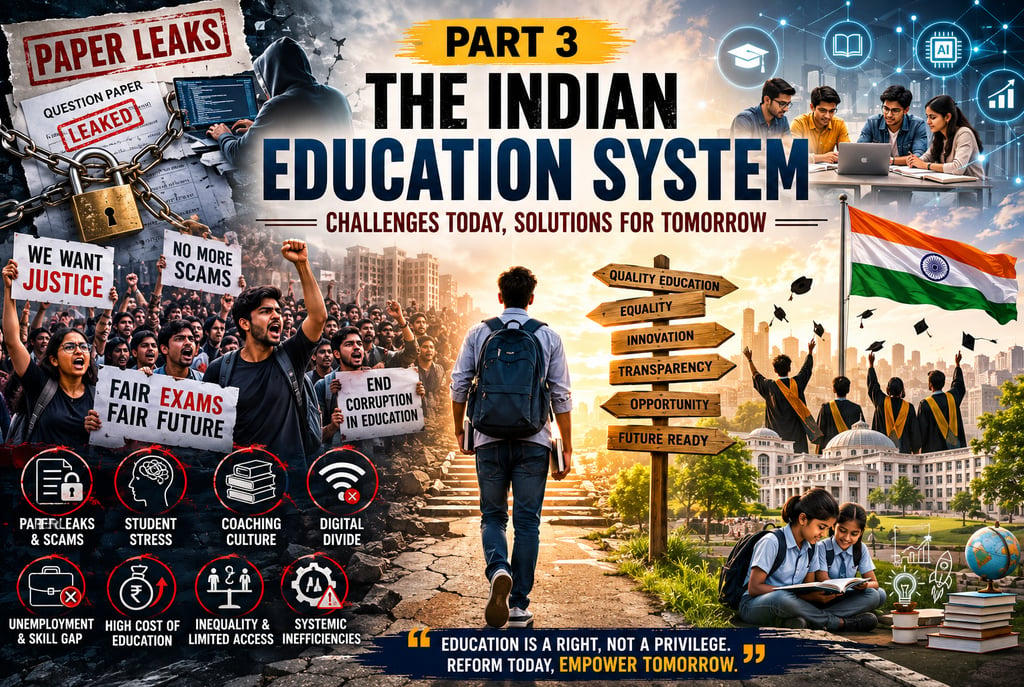
Despite these developments, the Indian education system today faces one of the most critical periods in its history. Every year, millions of students compete for limited seats in schools, colleges, universities, and government jobs. For many families, education represents the primary path toward economic mobility and social progress. Yet repeated examination scandals, paper leaks, recruitment irregularities, commercialization, mental health concerns, and unequal educational opportunities have weakened public confidence in the system.
This final part examines the contemporary challenges confronting Indian education and considers reforms that could help restore trust, fairness, and quality.
The Rise of Competitive Examinations
Since economic liberalization and the rapid expansion of higher education, India has witnessed an unprecedented increase in competitive examinations.
Every year, millions of candidates appear for examinations such as:
NEET
JEE Main and Advanced
CUET
UPSC Civil Services
SSC examinations
Banking recruitment
State Public Service Commission examinations
Railway recruitment
Police recruitment
Teacher Eligibility Tests (TET)
State government recruitment examinations
These examinations determine admission to prestigious institutions and access to stable public-sector employment.
With demand far exceeding available seats, competition has become extremely intense.
The Crisis of Examination Paper Leaks
One of the most serious challenges facing Indian education today is the recurring leakage of examination papers.
A paper leak occurs when confidential examination questions are illegally obtained and circulated before an examination, giving unfair advantage to some candidates while undermining the integrity of the assessment.
Paper leaks have affected numerous examinations conducted by both state and central authorities over the past two decades.
The consequences extend far beyond the cancellation of an examination. They affect public trust, delay recruitment, increase financial costs, and impose emotional burdens on students.
Major Examination Scandals
India has witnessed several high-profile controversies involving examination irregularities.
These include allegations or confirmed cases involving:
State recruitment examinations.
Teacher recruitment tests.
Police recruitment examinations.
Public Service Commission examinations.
Medical entrance examinations.
Engineering entrance examinations.
Staff Selection Commission recruitment.
Various state board examinations.
One of the most widely known recruitment scandals was the Vyapam Scam in Madhya Pradesh, which exposed large-scale manipulation involving admissions and recruitment processes.
More recently, controversies surrounding NEET and several state-level examinations have renewed public concern regarding examination security, transparency, and accountability.
Although the circumstances differ from case to case, these incidents have intensified demands for stronger examination systems.
How Paper Leaks Affect Students
For students, a paper leak represents much more than an administrative failure.
Many candidates spend:
One to three years preparing.
Significant family savings on coaching.
Thousands of study hours.
Considerable emotional energy.
When an examination is cancelled or delayed because of malpractice, students often experience:
Anxiety.
Depression.
Financial stress.
Loss of motivation.
Career uncertainty.
For candidates approaching age limits for government recruitment, repeated cancellations may permanently reduce future opportunities.
Commercialization of Education
Another major concern is the increasing commercialization of education.
Education, once regarded primarily as a public service and social responsibility, has increasingly become a competitive market.
The growth of:
Private schools.
Coaching institutes.
EdTech companies.
Private universities.
has expanded educational opportunities but has also increased financial pressure on many families.
Today, many students feel compelled to enroll in expensive coaching programmes in addition to regular schooling.
This has created concerns regarding equal opportunity, particularly for economically disadvantaged students.
The Coaching Culture
India's coaching industry has grown into a multi-billion-rupee sector.
Cities such as Kota, Hyderabad, Delhi, Pune, and several others have become major centres for entrance examination preparation.
Coaching institutes have helped countless students succeed, yet critics argue that excessive dependence on coaching has several drawbacks.
These include:
Reduced emphasis on conceptual learning.
Memorization-oriented preparation.
Long study hours.
Psychological stress.
Financial inequality.
Reduced importance of classroom teaching.
The existence of coaching culture also raises broader questions regarding the effectiveness of mainstream school education.
Mental Health Crisis Among Students
Academic pressure has become one of the defining features of modern education.
Students often face expectations from:
Parents.
Schools.
Society.
Coaching institutions.
Peer competition.
Many prepare for examinations over several years with little time for recreation or personal development.
Mental health professionals have highlighted increasing concerns regarding:
Examination anxiety.
Burnout.
Depression.
Loneliness.
Fear of failure.
These challenges underline the importance of integrating psychological support into educational institutions.
Digital Divide
Technology has transformed education through:
Online classes.
Digital libraries.
Artificial intelligence.
Virtual laboratories.
Educational applications.
However, digital progress has not reached every student equally.
Many rural and economically disadvantaged families continue to face difficulties relating to:
Internet connectivity.
Digital devices.
Electricity.
Technical infrastructure.
The COVID-19 pandemic particularly exposed these inequalities.
Quality Gap Between Government and Private Schools
India has made remarkable progress in expanding school enrollment.
However, significant differences remain in educational quality.
Many government schools continue to struggle with:
Teacher shortages.
Infrastructure limitations.
Laboratory facilities.
Digital resources.
Learning outcomes.
Private institutions often provide better facilities but may remain unaffordable for large sections of society.
Improving government schools remains essential for achieving educational equality.
Graduate Unemployment and Skill Gap
Every year, India produces millions of graduates.
Yet employers frequently report shortages of industry-ready skills.
Common concerns include:
Limited practical experience.
Communication skills.
Critical thinking.
Problem-solving ability.
Digital competence.
Research skills.
The challenge is therefore not only increasing enrollment but also improving employability.
Student Protests in India
Students have historically played an important role in shaping India's democratic discourse.
Throughout history, students have participated in movements concerning:
Educational reforms.
Fee increases.
Reservation policies.
Campus governance.
Employment opportunities.
Examination irregularities.
Social justice.
Recent years have witnessed protests in several parts of India following allegations of examination paper leaks and recruitment delays.
Students have demanded:
Transparent investigations.
Timely recruitment.
Fair examinations.
Accountability from authorities.
Stronger anti-cheating measures.
In some demonstrations, allegations of police use of force have also attracted public debate and scrutiny.
While individual incidents vary, these events reflect growing frustration among young people regarding the reliability of examination and recruitment systems.
Technology: A Solution and a Challenge
Technology has enormous potential to improve education.
Artificial Intelligence can assist in:
Personalized learning.
Adaptive assessments.
Language translation.
Digital classrooms.
Research assistance.
Blockchain technology has been proposed for:
Secure academic records.
Tamper-proof certificates.
Examination security.
However, technology also introduces challenges such as:
Data privacy.
Cybersecurity.
AI misuse.
Digital inequality.
The objective should therefore be responsible integration rather than technology alone.
The Need for Examination Reform
Experts have suggested several measures to strengthen examination integrity.
These include:
Encrypted digital question-paper distribution.
Last-minute secure paper generation.
Biometric verification.
Artificial Intelligence-based monitoring.
Independent auditing.
Stronger cyber-security.
Faster investigation of examination fraud.
Strict legal penalties for organized cheating networks.
Several governments have already begun implementing some of these measures, though their effectiveness continues to be evaluated.
Reimagining Indian Education
Looking beyond examinations, India's education system must prepare students for the twenty-first century.
Future education should encourage:
Critical thinking.
Scientific temperament.
Innovation.
Entrepreneurship.
Ethical leadership.
Environmental awareness.
Constitutional values.
Financial literacy.
Digital literacy.
Practical problem-solving.
Education should move beyond rote memorization toward genuine understanding and creativity.
Recommendations for the Future
A stronger education system requires coordinated reforms across multiple sectors.
Important priorities include:
Strengthening Government Schools
Greater investment in infrastructure, teacher training, digital resources, libraries, laboratories, and student support.
Teacher Development
Continuous professional training and improved recruitment standards.
Examination Security
Advanced technological safeguards, transparent investigations, and independent oversight.
Mental Health Support
Professional counselling services should become an integral part of schools, colleges, and universities.
Reducing Coaching Dependency
Improving classroom teaching so that school education itself adequately prepares students for higher education and employment.
Industry-Oriented Curriculum
Greater collaboration between educational institutions and industry to improve employability.
Research and Innovation
Higher investment in scientific research, university laboratories, startups, and interdisciplinary learning.
Equal Educational Opportunities
Ensuring that students from rural, economically disadvantaged, tribal, and marginalized communities receive access to quality education without compromising academic standards.
Conclusion
The history of Indian education is a story of extraordinary achievements, profound transformations, and continuing challenges.
Ancient India established some of the world's earliest centres of learning and made enduring contributions to mathematics, medicine, astronomy, philosophy, and literature. At the same time, historical inequalities limited educational access for many communities.
The medieval period introduced new intellectual traditions and institutions, while British colonial rule fundamentally reshaped educational administration, language, and higher education. After Independence, India sought to build a more inclusive system through constitutional guarantees, educational commissions, reservation policies, and successive National Education Policies.
Today, India possesses one of the largest education systems in the world. Yet recurring examination paper leaks, uneven educational quality, commercialization, student stress, skill gaps, and governance challenges continue to test public confidence.
The future of Indian education will not be determined solely by new policies or technological innovations. It will depend on transparent institutions, competent teachers, secure examination systems, inclusive opportunities, responsible use of technology, and a commitment to nurturing curiosity rather than rote learning.
Education is more than a means to secure employment—it is the foundation of an informed, innovative, and democratic society. If India succeeds in combining its rich intellectual heritage with modern reforms, accountability, and equal opportunity, its education system can become not only one of the largest in the world but also one of the most trusted and transformative.
End of Series
The Indian Education System: From Ancient Wisdom to Modern Challenges
Part 1: Ancient India, Gurukul System, Social Structure, and Medieval Education.
Part 2: Colonial Education, Independence, Reservation, and Educational Policies.
Part 3: Paper Leaks, Student Protests, Present Challenges, Future Reforms, and the Road Ahead.
"The strength of a nation is not measured by the number of its schools or universities, but by the fairness of its opportunities, the integrity of its institutions, and the quality of education it provides to every child."