The Foreign Hand: CIA Involvement in Anti India Activities
How the CIA was involve in many anti India Activities towards the assassination of the Homi bhabha to Indira Gandhi and several terrorism funding against India.
Meet R Parmar
3/13/202622 min read
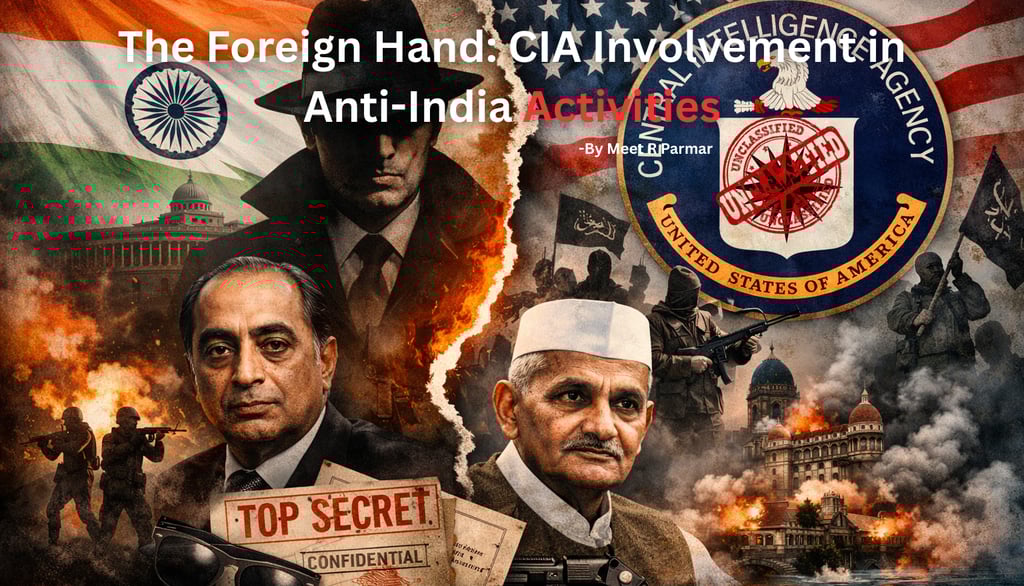
The Foreign Hand: A Comprehensive Examination of CIA Involvement in Anti-India Activities
Introduction
The narrative of foreign interference in India's domestic affairs has been a persistent theme throughout the nation's post-independence history. Among the intelligence agencies often cited in this context, the Central Intelligence Agency (CIA) of the United States features prominently in both documented operations and unverified allegations. This article examines the historical and contemporary claims of CIA involvement in activities perceived as anti-India, drawing distinctions between verified operations based on declassified documents and allegations that remain in the realm of speculation.
The relationship between Indian and American intelligence has been characterized by a complex interplay of cooperation and conflict—sometimes working jointly against common adversaries, at other times operating at cross-purposes. Understanding this nuanced history is essential for separating documented facts from the conspiracy theories that have often dominated public discourse.
1. Political Subversion in Kerala (1950s)
The first democratically elected communist government in the world, led by E.M.S. Namboodiripad in Kerala (1957-1959), became an early target of CIA covert action during the Cold War.
Documented Evidence:
According to former US Ambassador to India Ellsworth Bunker's biography, the CIA performed a clandestine operation to topple the Namboodiripad government. The plan involved funding an anti-government agitation in Kerala to create conditions that would force the central government to intervene . In 2007, CPI-M General-Secretary Prakash Karat publicly stated, "I have been supplied with documents that prove that the E.M.S. Namboodiripad-led Left government in Kerala in the '50s was dismissed with the active help of the CIA." Money was reportedly "pumped in" to destabilize the government, leading to the invocation of Article 356 of the Indian Constitution against the elected ministry .
Context:
This operation must be understood within the broader Cold War context, where the United States viewed any communist expansion—even through democratic means—as a threat to its global interests. The Kerala operation represented one of the earliest instances of direct CIA intervention in India's democratic processes.
2. Death of Homi Jahangir Bhabha (January 24, 1966)
The death of India's nuclear pioneer in a plane crash over Mont Blanc, just 13 days after Prime Minister Lal Bahadur Shastri's death in Tashkent, has spawned enduring conspiracy theories about CIA involvement.
The Conspiracy Theory:
The theory gained prominence through the SonyLIV series "Rocket Boys," which implied CIA involvement in Bhabha's death. Director Abhay Pannu cited a book by former CIA operative Robert Crowley, in which Crowley allegedly "confessed" that the conspiracy theory had factual basis . Proponents note that Bhabha had stated in October 1965—just months before his death—that India could develop a nuclear bomb within 18 months.
Contrary Evidence:
Director Pannu acknowledged that the show dramatized events and created fictional characters for narrative effect. He stated, "I wouldn't say that it's completely fictional, and I wouldn't say that it's completely factual. Of course, we've dramatised it a little bit" . An India Today report from 1978 noted rumors that Bhabha may have been carrying important classified documents related to a mini-nuclear power project in the Himalayas, which allegedly disappeared after a Pakistani diplomat reached the crash site first.
Verdict:
No official or declassified evidence has ever corroborated the theory that the CIA was responsible for Bhabha's death. The timing of his death—so close to Shastri's—and its proximity to India's nuclear ambitions have fueled speculation, but the theory remains unproven.
3. Death of Lal Bahadur Shastri (January 11, 1966)
Prime Minister Lal Bahadur Shastri's death in Tashkent, hours after signing the Tashkent Agreement with Pakistan, remains one of independent India's most enduring mysteries .
Suspicious Circumstances:
The suddenness of Shastri's death in neutral Soviet territory stunned the nation. At the time of his death, Shastri's popularity was at its peak following India's military success in the 1965 war. According to veteran journalist Kuldip Nayar's account, Shastri had told him that in the event of further reverses on the border, "Either a pro-America military Government would take over or the country would split like Indo-China" .
Nayar's detailed reconstruction of the fateful night describes how Shastri retired around 10 PM, had a frugal meal, received a disappointing phone call from his family who had not liked the Tashkent agreement, and was found in distress around 1:30 AM. His slippers neatly placed near the bed suggested he walked barefoot to a dressing table to get water .
The CIA Angle:
The conspiracy theory suggests that Shastri was proving to be "a difficult nut to crack" in US efforts to befriend China via Pakistan. Two years after Shastri's death, Nixon was sworn in as president, and Henry Kissinger was laying groundwork for US rapprochement with China through Pakistan.
Contrary Evidence:
Eyewitness accounts from officials present in Tashkent have consistently dismissed conspiracy theories. The blotches on the body were explained as part of the embalming process . Historian Ramachandra Guha in India After Gandhi writes that Shastri "died in his sleep of a heart attack" . However, the government's continued refusal to declassify one document related to Shastri's death—citing potential harm to relations with a "friendly nation"—keeps speculation alive .
Verdict:
No official evidence implicates the CIA. The theory remains speculative, though the circumstances continue to invite questions.
4. CIA Role in 1971 India-Pakistan Conflict
The 1971 war represents perhaps the best-documented case of US policy toward the subcontinent, revealing not covert action against India but an intelligence failure compounded by a pro-Pakistan "tilt."
The Intelligence Failure:
Contrary to popular perception of CIA omniscience, declassified documents reveal the agency had little accurate intelligence on the crisis. At a Washington Special Actions Group (WSAG) meeting on August 17, 1971, CIA Director Richard Helms told Henry Kissinger, "My personal feeling is that they will not do so" when asked if India would attack—this at a time when India had nearly completed war preparations.
By November 24, 1971, Kissinger's frustration was evident: "Why do we have no independent intelligence? The question is what hard data we have to support whatever action we want to take. We have no doubt that India is involved and that they are probably across the border. But we need something to nail down the exact nature of their activities."
The "Tilt" Toward Pakistan:
The Nixon administration's policy favored Pakistan, driven by Cold War geopolitics—using Pakistan as a conduit for secret diplomacy with China. This "tilt" included the illegal transfer of American military equipment to Pakistan via third countries like Jordan, violating congressional legislation.
Post-War Controversy:
Years later, journalist Seymour Hersh alleged that Morarji Desai had been a CIA asset during the war—an accusation Desai vehemently denied, filing a lawsuit in American court. The controversy forced Kissinger to testify publicly about CIA operations in India, though the allegations were never officially confirmed . According to Cambridge University Press research by Paul M. McGarr, the Hersh book "served as a cause celébère, and saw Kissinger forced to publicly testify on CIA operations in India" . The book Mission R&AW clarifies that another Indian politician, Y.B. Chavan, was the main suspect instead of Morarji Desai in this regard .
Verdict:
The CIA's role was characterized by intelligence failure in service of a policy favoring Pakistan, not covert action against India per se. The agency was caught off-guard by India's military intervention.
5. India's First Nuclear Program: The "Smiling Buddha" Intelligence Failure
India's first successful nuclear test, codenamed "Smiling Buddha" (Pokhran-I), conducted on May 18, 1974, represents one of the most significant intelligence failures in CIA history—not a successful CIA operation against India.
The Intelligence Failure
Complete Surprise:
The test "caught the US by surprise in part because the intelligence community had not been looking for signs that a test was in the works." A declassified CIA post-mortem from July 1974 analyzed why the agency and its sister organizations failed to predict the test.
Why the CIA Missed It:
Several factors contributed to this intelligence failure:
Lack of priority: Nixon administration policymakers assigned a low priority to the Indian nuclear program for intelligence collection. Intelligence production "fell off" during the 20 months before the test (from October 1972 to May 1974)
Communication breakdown: There was a lack of communication between intelligence producers (analysts) and intelligence collectors. The agency focused more on "capabilities" than on "intentions"
No sense of urgency: The post-mortem saw no "sense of urgency" in the intelligence community, which may have "reflected the attitudes of the policymakers"
Satellite Imagery Failure:
The report noted that NRO satellites had imagery of the Thar Desert that could have been scrutinized for suspect activity, but no one asked the National Photographic Intelligence Center to look into it. "The failure of production elements to ask NPIC to exploit photography that had been specifically requested from the National Reconnaissance Office suggests a weakness in the imagery requirements system."
The INR Warning Ignored
In early 1972, two years before the test, the US State Department's Bureau of Intelligence and Research (INR) predicted India could make preparations for an underground test without detection by American intelligence. The INR report warned the US government had given a "relatively modest priority" to relevant intelligence collection activities. The White House was more focused on the Vietnam war and "a grand strategy" towards Beijing and Moscow.
However, when a small spate of reports about a possible test emerged, "government officials (US) could not decide whether India had made a decision to test although a subsequent lead suggested otherwise."
Technical Assessment of the Test
Declassified US intelligence assessments later characterized the test as a "near failure." A January 24, 1996 intelligence assessment revealed that India's nuclear design "probably needed significant reworking after the near failure of the 1974 test" . The Federation of American Scientists estimated the actual yield was in the range of four to six kilotons, lower than the 8-12 kilotons officially claimed .
The US Response
Kissinger's Restrained Reaction:
A declassified May 1974 cable from Secretary of State Henry Kissinger reveals the immediate US response. He advised against a "worldwide reaction" that would "antagonize India to no benefit." Instead, he ordered a "comprehensive review" of non-proliferation policy to avoid "shooting from the hip."
Policy Shift:
The test created "shock waves" in Washington and elevated nuclear proliferation from a lower-level issue to a higher policy priority for the US government. It led to the formation of the Nuclear Suppliers Group (NSG) to control nuclear proliferation.
Irony: CIA Had Earlier Aided India's Nuclear Program
In a twist of historical irony, the CIRUS nuclear reactor that produced the plutonium for Smiling Buddha was given to India by Canada as part of an understanding with the United States under the Atoms for Peace programme. Heavy water supplied by the US was also used in the production of nuclear material for the bomb. The very program the CIA later failed to detect had been enabled, in part, by earlier American assistance.
Verdict:
The CIA did not conduct sabotage against India's nuclear program. To the contrary, India's "Smiling Buddha" stands as a landmark event in intelligence history precisely because of the CIA's failure to detect it. The operation's success highlighted the effectiveness of India's secrecy under Prime Minister Indira Gandhi and prompted a significant overhaul of how the US gathered intelligence on global nuclear programs.
6. Assassination of Indira Gandhi (October 31, 1984)
The assassination of Prime Minister Indira Gandhi by her Sikh bodyguards has been the subject of persistent allegations regarding foreign involvement.
Academic Analysis:
According to Cambridge University Press research by Paul M. McGarr, the assassinations of Indira and Rajiv Gandhi "came to be connected by South Asians with the Agency and its earlier CIA involvement in subversion and political assassination in the Global South" . This connection stemmed from the CIA's documented history elsewhere, not from evidence in these specific cases. McGarr notes that "to the very end of the Cold War, the political fortunes of Indira Gandhi, and her son, and successor, Rajiv Gandhi, were intertwined with a series of espionage scandals in which, almost inevitably, the CIA figured prominently" .
The Soviet Disinformation Campaign:
Immediately after the assassination, the Soviet Union launched a propaganda campaign blaming the CIA—hoping to damage US-India relations and protect its strategic partnership with Indira Gandhi. US officials condemned these allegations as "Soviet-inspired disinformation."
Declassified Documents:
CIA documents from the period show the agency was analyzing political succession scenarios following Indira Gandhi's death—standard intelligence practice, not evidence of operational involvement.
Verdict:
No credible evidence links the CIA to Indira Gandhi's assassination. The persistent suspicions reflect the CIA's broader Cold War history rather than specific involvement in this event .
7. Rabinder Singh: The CIA Mole in RAW
The case of Rabinder Singh represents the most damaging documented penetration of Indian intelligence by the CIA in recent decades.
The Recruitment:
Singh, an army Major who joined RAW in the mid-1980s, was reportedly recruited by the CIA in the early 1990s during postings in Damascus or The Hague. According to reports, he was "honeytrapped" by a female CIA case officer.
The Operation:
According to the book Mission R&AW by R.K. Yadav, a former RAW officer, "CIA had a Mole in R&AW as Rabinder Singh, Joint Sec. Information and documents were given by more than 50 officers of R&AW. 19 of these officers were indicted by the inquiry officer. None was prosecuted in the court" . The CIA trained Singh to pass classified documents without direct meetings. He frequently traveled to Nepal for secret meetings with handlers and to collect payments. Money was also delivered to his children in the United States.
The Escape:
In December 2003, RAW's Counter-Intelligence Division began surveillance after suspecting Singh was a mole. By May 1, 2004, tipped off that he was under suspicion, Singh fled to Nepal with CIA assistance. A CIA operative booked hotel rooms in Nepal under his real name—a critical mistake that exposed the nexus. Flight tickets for Singh and his wife were billed to the US Embassy in Kathmandu.
Aftermath:
The couple was issued US passports under false names and evacuated to Washington, bypassing immigration procedures. Investigation revealed that 57 RAW officers had been sharing intelligence with Singh, with around two dozen actively collaborating in leaking classified information to the CIA . Singh died in a road accident in Maryland in 2016.
Verdict:
This is a documented case of successful CIA penetration of Indian intelligence, representing a major compromise of India's national security.
8. CIA Role in 1999 Kargil Conflict
The Kargil War saw an indirect but significant CIA dimension through weaponry originally supplied for the Afghan conflict.
Stinger Missiles in Kargil:
During the Afghan war, the CIA had flown hundreds of Stinger surface-to-air missiles into Pakistan. After the Soviet withdrawal, the CIA launched a $10 million operation in 1994-95 to recover unused Stingers from Afghan guerrillas. The operation largely failed .
The Pakistani Connection:
The "missing" Stingers were deployed by Pakistani intruders in Kargil in 1999, damaging a Canberra aircraft and downing a Mi-17 helicopter. Intelligence officials stated that the ISI and Afghan guerrillas had made "CIA field officers and agents sit on a merry-go-round," recovering only a few missiles at very high prices . The CIA was offering upwards of $80,000 per missile and estimated that 120 Stingers were missing .
The Irony:
The CIA's failure to recover weapons it had supplied to fight the Soviets meant those same weapons were used against India in Kargil. Pakistani intruders fired approximately 15 Stingers from the Tololing feature .
In a widely read book, The Bear Trap, Brigadier Mohammed Youssaf, who handled the ISI's Afghan operations, hinted that some missiles were "stolen" by Pakistan rather than passed to Afghan guerrillas .
Verdict:
While not a direct CIA operation against India, the agency's failure to secure its weapons pipeline to Afghan mujahideen resulted in those weapons being used against Indian forces. The CIA was an indirect facilitator through its earlier arming of Islamist fighters in Afghanistan.
9. CIA Involvement in 1993 Bombay Bomb Blasts
The 1993 serial bomb blasts in Mumbai, which killed over 250 people, triggered offers of intelligence cooperation from the CIA.
The CIA Offer:
According to former RAW officer B. Raman's book "The Kaoboys of RAW: Down Memory Lane," after the 1993 Mumbai blasts, the CIA offered to "organize a dialogue" between RAW and the ISI—essentially proposing a joint counter-terrorism mechanism . Then CIA Director James Woolsey visited Islamabad to meet Pakistani Prime Minister Nawaz Sharif before making this offer.
India's Rejection:
Prime Minister P.V. Narasimha Rao rejected the offer. Raman quotes Rao as saying, "The RAW has been having a relationship with the CIA for 25 years. It has not been able to get its cooperation in counter-terrorism. Before suggesting to us counter-terrorism cooperation with Pakistan, let the US first cooperate sincerely with us in counter-terrorism" . Rao considered it a "dangerous illusion" to expect useful outcomes from RAW-ISI cooperation.
Context:
Raman's book also reveals that French intelligence had penetrated the Prime Minister's Office in the early 1980s, sharing intelligence with Western counterparts—suggesting CIA operated in India through third-country intelligence agencies to avoid surveillance by the IB, given Indira Gandhi's well-known distrust of the US . "The CIA felt its own officers would be under close surveillance by the IB due to Indira Gandhi's well-known distrust of the US. It therefore operated through the intelligence agencies of other countries, which were not under similar surveillance till the detection of the penetration of the PMO by French intelligence" .
Verdict:
The CIA offered post-blast cooperation rather than being implicated in the blasts themselves. No evidence links the CIA to the 1993 bombings.
10. CIA Involvement in 2001 Indian Parliament Attack
The December 13, 2001 attack on the Indian Parliament brought India and Pakistan to the brink of war, with the CIA playing a controversial role in intelligence assessments.
The Intelligence Controversy:
According to former US National Security Advisor Condoleezza Rice's memoir "No Higher Honor," the CIA and Pentagon gave diametrically opposite assessments of Indian intentions after the attack. The CIA believed armed conflict was "unavoidable because India had already decided to 'punish' Pakistan" .
The Pakistani Source Problem:
Rice revealed a critical flaw: "The CIA was heavily reliant on Pakistani sources in 2001." The agency was "speaking the language of Pakistan, which wanted the entire world to believe, in particular the US, that India was ready to attack them" .
The Nuclear Dimension:
Rice disclosed that India had deployed nuclear-capable missiles on its western border and was preparing to move short-range ballistic missiles capable of carrying nuclear warheads to the border—refusing to budge under US pressure for talks with Pakistan .
"The fact is that after years of isolation from India, a country that had viewed the United States with suspicion for decades, the CIA was heavily reliant on Pakistani sources in 2001," Rice writes .
Verdict:
The CIA's role was not in orchestrating the attack but in providing assessments colored by Pakistani sources—potentially misleading US policymakers about Indian intentions. This represents intelligence failure through dependency on Pakistani information, not operational involvement in the attack.
11. CIA Involvement in 26/11 Mumbai Attack (2008)
The 2008 Mumbai attacks, which killed 166 people, have been consistently attributed to Lashkar-e-Taiba (LeT), a Pakistan-based terrorist organization with deep ties to the ISI. While the CIA was not implicated in the attacks themselves, the agency played a significant role in the aftermath through intelligence cooperation.
The CIA's Role Post-26/11:
According to subsequent reporting, the CIA provided critical intelligence that helped India trace the origins of the attacks back to Pakistan. The agency shared communications intercepts and other intelligence that confirmed the handlers directing the terrorists were located in Pakistan.
The David Coleman Headley Connection:
Headley, an American citizen of Pakistani descent, was arrested by the FBI in 2009 for his role in scouting locations for the 26/11 attacks. His cooperation with US authorities after his arrest provided invaluable intelligence about LeT's operations and its connections to the ISI. This cooperation was facilitated by the CIA and FBI, demonstrating the complex relationship where US agencies simultaneously pursued terrorists while Pakistan's ISI allegedly sponsored them.
Verdict:
No evidence links the CIA to the planning or execution of 26/11. The attacks were planned and executed by LeT with ISI support. The CIA's involvement came after the attacks, through intelligence sharing with India and the prosecution of Headley.
12. CIA Involvement in Uri Attack (2016)
The September 18, 2016 attack on an Indian Army brigade headquarters in Uri, Kashmir, which killed 19 soldiers, was attributed to Jaish-e-Mohammed (JeM), another Pakistan-based terrorist group.
US Response Pattern:
The Uri attack established a pattern of US response that would be repeated in subsequent terror strikes. Following Uri, the US offered condolences, supported India's right to self-defence, and urged de-escalation—a balanced approach that critics argue tacitly accommodated Pakistan's proxy war.
The De-escalation Playbook:
After Uri, US Secretary of State John Kerry held conversations with then Indian foreign minister Sushma Swaraj, asking her not to escalate the situation with Pakistan. This represented the first instance of what would become a consistent US strategy: acknowledging India's right to respond while privately urging restraint.
India's Response:
India conducted surgical strikes across the Line of Control in response to Uri—a calibrated military action that received tacit US understanding. The strikes targeted terrorist launch pads but avoided escalating to full-scale conflict.
Verdict:
No evidence links the CIA to the Uri attack. The attack was planned and executed by JeM with ISI support. The US role was limited to diplomatic engagement and encouraging restraint.
13. CIA Involvement in Pulwama Attack (February 14, 2019)
The Pulwama suicide bombing, which killed 40 CRPF personnel, marked a significant escalation in Pakistan's proxy war against India and drew intense international scrutiny.
The Attack and Its Attribution
The attack was claimed by Jaish-e-Mohammed (JeM), a Pakistan-based terrorist organization with historical ties to both the ISI and, indirectly, to the CIA through the Afghan jihad infrastructure of the 1980s.
US Intelligence Community Response:
Following the attack, former CIA analyst Bruce Riedel stated that JeM claiming responsibility "raises serious questions about the role of the ISI in supporting the masterminds of this operation." He noted that the attack had "direct footprints inside Pakistan."
The White House issued a strong statement asking Pakistan to "end immediately the support and safe haven provided to all terrorist groups operating on its soil." The State Department specifically noted that a "United Nations-designated, Pakistan-based terrorist group" had claimed responsibility.
The CIA-ISI Nexus Question
Background of the Relationship:
The covert collaboration between the CIA and ISI remains one of the least acknowledged realities of South Asian geopolitics. Beyond counterterrorism rhetoric, this partnership has produced outcomes that weaken India's security architecture while sustaining Pakistan's deep state.
Post-Pulwama Intelligence Sharing:
According to subsequent reports, after Pulwama, the Pakistan Army shared intelligence inputs on militant attacks with India via the CIA as it attempted to reopen back-channel dialogue with New Delhi. The Pakistan Army "shared warnings on terrorist attacks through the Central Intelligence Agency, and acted against the leadership of several jihadist groups."
This intelligence sharing occurred in the context of the "London dialogue"—a secret channel between RAW and ISI that had been established in 2018 but was disrupted by the Pulwama attack.
US Diplomatic Response
The US adopted a calibrated approach after Pulwama:
Public Support: The US supported India's right to self-defence and condemned the attack
De-escalation Pressure: Behind the scenes, US officials urged restraint and encouraged direct communication between India and Pakistan
Balanced Messaging: Then-US President Donald Trump stated he "understood" why India sought a strong response, while Secretary of State Mike Pompeo asked both sides to avoid further escalation
Verdict:
The CIA was not involved in planning or executing the Pulwama attack. The attack was carried out by JeM with ISI support. The CIA's role was limited to post-attack intelligence sharing and facilitating back-channel communications between India and Pakistan. However, critics argue that the CIA-ISI nexus—forged during the Afghan jihad—created the infrastructure that ultimately enabled groups like JeM to operate against India.
14. CIA Involvement in Pahalgam Attack (April 22, 2025)
The Pahalgam terror attack, which killed 26 innocent civilians including several tourists, has become the most extensively documented case of potential Western complicity in anti-India terrorism through commercial technology channels.
The Geospatial Intelligence Scandal
The BSI-Maxar Connection:
Investigative reporting revealed that a Pakistani geospatial company, Business System International Pvt Ltd (BSI), owned by Obaidullah Syed, illegally acquired satellite imagery from US-based Maxar Technologies and resold it to Pakistani government agencies, including those linked to nuclear weapons development.
Syed and his company had deep links with Pakistan's Atomic Energy Commission (PAEC) and the National Development Complex (NDC)—two powerful arms of Pakistan's defence and nuclear programme responsible for building nuclear weapons and missile systems. His actions violated US export laws because he exported satellite imagery to entities listed on the US Entity List without required licences.
Pre-Attack Imagery Orders:
Critical findings revealed that:
BSI was listed as a partner of Maxar Technologies, one of the top satellite imagery firms based in Colorado
After becoming a Maxar partner, BSI's portal showed a sudden spike in orders for high-resolution satellite images of Pahalgam in Kashmir
These orders appeared just two months before the April 22, 2025 terror attack
The images were likely shared with on-ground terror groups through alternate communication channels
US Government Response:
Following publication of these findings, Maxar removed BSI from its partner page and denied that BSI had ordered the Pahalgam images. However, questions remained about whether adequate due diligence was conducted before listing BSI as a partner.
The CIA-ISI Nexus in Pahalgam
Wider Strategic Context:
Analysts have noted that Pakistan's proxy war against India is sustained not only by its own deep state but also by the "silent complicity of external powers." The CIA-ISI nexus—a "marriage of convenience"—ensures Pakistan is never fully isolated, and India never fully unencumbered. For Washington, Pakistan provides deniability, access, and leverage; for Islamabad, it provides survival and cover.
The Geospatial Threat:
The Pahalgam case highlighted how democratized access to geospatial datasets has opened these resources to terrorist forces, non-state actors, and proxies. Commercial space imagery, once restricted solely to strategic government agencies, is now accessible to individuals and businesses—creating vulnerabilities that terrorist groups can exploit.
US Diplomatic Response to Pahalgam
The US response to Pahalgam followed the established pattern seen after Uri and Pulwama:
Public Condemnation and Support:
US Secretary of Defence Pete Hegseth called Indian Defence Minister Rajnath Singh, conveying "deepest sympathies for the tragic loss of innocent civilians" and reaffirming US solidarity with India
Hegseth stated that "the US stands in solidarity with India and supports India's right to defend itself" and reiterated Washington's commitment to supporting India in its fight against terrorism
De-escalation Pressure:
US Secretary of State Marco Rubio encouraged India to "work with Pakistan to de-escalate tensions and maintain peace and security in South Asia"
Rubio held separate conversations with Pakistan Prime Minister Shehbaz Sharif, urging both sides to step back from confrontation
Criticism of the US Approach:
Sources indicated that the US was essentially "doing a repeat of its strategy after the 2016 Uri attack and the 2019 Pulwama attack"—backing India's limited counter-strike on terrorism while urging no further escalation, and telling Pakistan to act against terrorists on its soil.
This balanced approach drew criticism from those who viewed it as insufficiently condemnatory of Pakistan's state-sponsored terrorism. In the Lok Sabha debate, DMK MP Kanimozhi questioned the absence of global support: "Do you have no friends, no friendly neighbours to condemn a country which is sponsoring terrorism against India?"
US Article 370 Stance and Kashmir Policy
Historical US Position on Article 370:
The United States has historically maintained a policy of neutrality on the Kashmir dispute, calling for bilateral resolution between India and Pakistan. This position has been criticized in India as implicitly legitimizing Pakistan's claims.
Post-2019 Abrogation:
India's abrogation of Articles 370 and 35A in August 2019 was a strategic shock to Pakistan's playbook. The move dismantled separatist structures, outlawed organizations like the Hurriyat, Jamaat-e-Islami, and JKLF, and allowed New Delhi to establish direct governance. Militant recruitment subsequently collapsed to historic lows.
Interestingly, the book Mission R&AW notes that "Article 370 was enacted by Jawaharlal Nehru to appease Sheikh Abdullah who later betrayed him. IB ultimately arrested Sheikh for treason" . It further elaborates that Sheikh Abdullah desired independent status for J&K, and when evidence of his hobnobbing with Pakistan was found, the Intelligence Bureau got him arrested .
US Congressional Reaction:
While the Trump administration at the time did not impose sanctions or take punitive action against India, some US congressional figures expressed concern about the move. The administration's public position emphasized that Kashmir was a bilateral issue for India and Pakistan to resolve.
The Pakistan Adaptation:
Following the abrogation, the ISI redirected its proxies to strike at Kashmir's economic arteries. The Pahalgam massacre of tourists was emblematic of this recalibration—an attack not only on lives, but also on tourism, investment, and the very narrative of normalcy in Kashmir.
Trump's Claim of Intervention
In his State of the Union Address following the Pahalgam attack, former President Donald Trump claimed that he had ended a potential India-Pakistan conflict, stating that Pakistan's Prime Minister told him 35 million people would have died without his intervention.
India's Denial:
India officially denied any US involvement in the agreement to cease hostilities with Pakistan, maintaining that the request to end military operations had come from the Director General of Military Operations in Pakistan.
Operation Sindoor and Indian Response
India initiated Operation Sindoor on May 7, 2025, in the aftermath of the Pahalgam attack. The operation was a punitive and targeted campaign to dismantle terror infrastructure across the Line of Control and deeper inside Pakistan.
The Indian Air Force conducted high-impact air operations on targets including the Nur Khan Air Base and the Rahimyar Khan Air Base. The operation unfolded across land, air, and sea, demonstrating synergy between the Indian Army, Air Force, and Navy.
Verdict:
The Pahalgam attack represents a complex case where American commercial technology was allegedly exploited by Pakistani entities to conduct pre-attack surveillance. While no direct CIA involvement has been established, the incident raises serious questions about inadequate oversight of US geospatial companies and their partnerships with entities linked to Pakistan's military-intelligence establishment. The US diplomatic response followed the established pattern of public support for India's right to self-defence coupled with private pressure for de-escalation.
15. CIA Establishment of ISIS, Al-Qaeda, Mujahideen Against India
The claim that the CIA established ISIS, Al-Qaeda, and mujahideen specifically "against India" requires careful unpacking.
The Afghan-Soviet War Context:
During the 1980s, the CIA, in cooperation with Pakistan's ISI, armed and trained mujahideen fighters to combat Soviet forces in Afghanistan. This operation—one of the largest covert actions in CIA history—created the infrastructure, networks, and ideological momentum that later spawned Al-Qaeda and eventually ISIS.
The Blowback:
The CIA's arming of Afghan mujahideen was directed against the Soviet Union, not India. However, the weapons and networks created during this period—including Stinger missiles that later appeared in Kargil—were subsequently used against Indian forces and civilians. Brigadier Mohammed Youssaf, who handled the ISI's Afghan operations, hinted that some missiles were "stolen" by Pakistan rather than passed to Afghan guerrillas .
The CIA-ISI Nexus:
The covert collaboration between the CIA and ISI forged during the Afghan jihad created a lasting relationship that analysts describe as a "marriage of convenience." This partnership ensured that Pakistan's military-intelligence establishment would never be fully isolated by the West, and that the infrastructure of jihad created for Afghanistan would be preserved—eventually to be turned against India.
The ISIS Connection:
While Al-Qaeda emerged directly from the Afghan jihad infrastructure, ISIS's connection to CIA operations is more indirect—emerging from the Iraq War's aftermath and the broader destabilization of the Middle East. The "CIA created ISIS" narrative is an oversimplification rejected by most terrorism scholars.
Verdict:
The CIA did create the mujahideen infrastructure in Afghanistan, and that infrastructure's remnants have been used against India. This represents unintended "blowback" rather than targeted anti-India operations. The agency's focus was the Soviet Union; India was collateral damage.
16. CIA Weapon Supplies to Pakistan Against India
The Stinger missile case documented in Kargil represents the clearest example of CIA-supplied weapons being used against India .
The Pipeline:
During the Afghan conflict, the CIA flew hundreds of Stingers into Pakistan. The ISI took responsibility for training Afghan guerrillas with these missiles—and is believed not to have passed all remaining Stingers to the Afghans.
The Failure to Recover:
When the CIA launched a 1994-95 operation to buy back unused Stingers, it became a "wild goose chase." The ISI and Afghan guerrillas extracted high prices for minimal returns, and the agency declared approximately 120 Stingers "missing" .
The Result:
These "missing" Stingers were deployed against India in Kargil in 1999. Pakistani intruders fired approximately 15 Stingers from the Tololing feature, damaging a Canberra aircraft and downing a Mi-17 helicopter .
The Pattern:
This represents a recurring pattern: CIA weapons and training provided for one purpose (anti-Soviet operations) are repurposed for anti-India operations by Pakistan. The agency loses control over its supply chain, and India pays the price.
Verdict:
CIA weapon supplies to Pakistan for Afghan operations have repeatedly been diverted for use against India—a form of indirect complicity through inadequate oversight.
17. US and CIA Views on Article 370 in Kashmir
Historical US Policy on Kashmir
The United States has historically maintained a position of neutrality on the Kashmir dispute, consistently calling for bilateral resolution between India and Pakistan. This stance, while ostensibly even-handed, has been criticized in India as effectively legitimizing Pakistan's claims and rewarding its policy of cross-border terrorism.
The 2019 Abrogation: US Response
India's abrogation of Articles 370 and 35A in August 2019 fundamentally altered the Kashmir paradigm. The move dismantled the special status that had been a source of separatist politics and legal ambiguity for seven decades.
Interestingly, historical context from the book Mission R&AW reveals that "Article 370 was enacted by Jawaharlal Nehru to appease Sheikh Abdullah who later betrayed him. IB ultimately arrested Sheikh for treason" . The book further notes that Sheikh Abdullah desired independent status for J&K, and when evidence of his hobnobbing with Pakistan was found, the Intelligence Bureau got him arrested .
The Trump Administration's Position:
The Trump administration's public response was notably muted. While some congressional figures expressed concern about the situation in Kashmir, the administration did not impose sanctions or take punitive action against India. Then-President Trump offered to mediate the Kashmir dispute—an offer India promptly declined, consistent with its longstanding position that Kashmir is a bilateral issue.